


Revenue Growth & Talent Shortages: What 25 CoinFund Founders Forecast for 2026
By CoinFund Managing Partner & Head of Venture Investments David Pakman and Head of Platform Jenna Pilgrim
Download the full report and methodology.
For the past three years, we have polled CoinFund portfolio companies* to gain insights on how they view the broader crypto market and what they think is to come in the year ahead.
In 2023, they reported cautious optimism in a rocky regulatory regime, with very few companies intending to raise capital in an uncertain financing environment.
In 2024, our CEOs predicted 2025 would be the Year of the Consumer – with growth in prediction markets and DeFi leading the way towards real-world adoption.
In this year’s survey, our respondents highlighted three trends for the year to come. For 2026, our founders voiced their thoughts on the following: web 3 AI companies’ ability to attract and retain talent, infrastructure companies’ ability to build robust sales processes, and the new class of tech giants shopping for specific company archetypes to acquire.
The AI Talent Crunch Continues
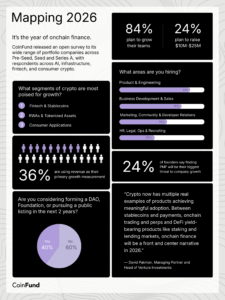
Given the broader tech giants are conducting layoffs and downsizing, we were pleased to see that 84% of respondents plan to grow their team in the coming year. This continues to be most relevant for our decentralized AI companies – Prime Intellect, Pluralis Research, Perle AI, Bagel, Gensyn, and Bloom – where their ability to attract and retain talent is the differentiating factor in an ever-increasing AI talent crunch.
This talent shortage is exhibiting itself across the board, from sourcing to training to retention. Engineers trained by top organizations need to increasingly believe in the long-term vision of a company and its potential to grow into something *really* big. Recently, we were speaking with a recruiter for a few large AI companies, and they specified that new clients had to have raised more than $15M in Venture Financing to be considered, as they need reassurance that clients can pay market competitive compensation rates when and if the candidate takes the call.
Time To Make Money
It seems that our portfolio companies are taking the hint from Uniswap’s fee switch and deciding now is the time to prioritize making money over significantly subsidizing growth. 56% of respondents said they are experiencing revenue growth and find monetization “important” or extremely important” going into 2026.
It’s encouraging to see companies are tracking toward typical VC valuation models based on revenue benchmarks, which should bode well for fundraising coming into the next year. Good thing, as 20% of respondents state they are seeking to raise more than $25M next year. Companies in the portfolio that have found product-market-fit and replicable sales models such as Li.Fi, Hello Moon, Rhinestone and Dakota are experiencing both the success and organizational challenges that come with building a robust sales engine. We have observed that the sophistication of internal sales processes at our portfolio companies are at an all-time high, and founders are moving beyond founder-led sales into well-oiled and repeatable motions.
The increased focus on go-to-market has moved these portfolio companies into a talent crunch, with the highest recurring talent request being Head of Institutional Sales. 76% of survey respondents cited Business Development and Sales as their most important hiring vertical for the upcoming year.
It’s been fascinating to watch web3 Sales teams take notes from their Web 2.0 counterparts — where robust sales processes are widely understood — and adapt them to web3’s differentiated needs. These portfolio companies are quickly realizing that it’s easier to onboard a Web 2.0 salesperson and educate them on web3 rather than the other way around. We expect to see an increase in sales formalization across the board going into 2026, especially in top-of-funnel sourcing and account growth.
Challenger Banks & Acquisitions Are Leading the Way
With the wave of adoption in stablecoins and the expanding world of prediction markets, portfolio companies are increasingly watching large tech firms to identify the next wave of consumer behavior. Acquisitions by Coinbase, Stripe, Robinhood are creating full suites of consumer offerings, and companies worry about competing for fewer and fewer opportunities to offer differentiated consumer products.
In crypto bull markets of the past, the crypto industry assumed the large-scale adoption – and thereby acquisition opportunities – would come from traditional corporations and large financial institutions, those that had large enough checkbooks to pay the higher valuation premiums that bull markets often command. We saw a number of organizations emerge that were aimed at bringing Fortune 500 corporations onchain, such as the The R3 Consortium (2014), the Hyperledger Project (2015), the Enterprise Ethereum Alliance (2017), and the Association for Digital Asset Markets (2018). This cycle, however, we have seen companies acquired opportunistically (Privy’s low-hundred-millions acquisition by Stripe, for example) by the faster-moving “challenger” companies such as Stripe, Robinhood, Polymarket, and Coinbase. These challenger companies are still founder-run and operate at the speed of tech companies, not slower incumbent financial services companies. As such, they move quickly and accept the higher market values — making it more likely deals get done.
We see this as a net positive even though these acquirers are fewer in number – as it makes product distribution the differentiating factor for companies in combination with their technical advantages, rather than in contrast to it. This has prompted these portfolio companies to spend a lot more time on who is using their product and for what, rather than delving deeper into the mindset of if you build it, they will come.
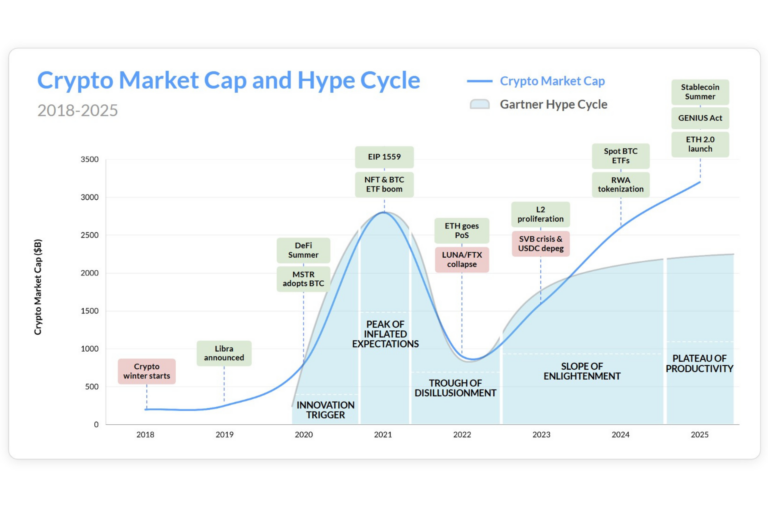
As our previous piece “The Long Arc of Crypto” details, crypto market growth has tipped into the mainstream, and traditional finance is converging with modern blockchains. This is leading to broader growth within our portfolio and more opportunities for revenue, fundraising and acquisition exits. Our founders report optimism about the year ahead coupled with plenty of challenges often found in startup land. We end 2025 optimistic about the year ahead, and look forward to sharing more thoughts as our founders update us.
For further founder insights and methodology, download the full report.
*Survey was requested of all 80+portfolio companies. The 25 included in analysis were the companies to reply by publication deadline and represent a cross-section of web3 including but not limited to infrastructure, AI, ZK, DeFi, gaming and consumer applications.
***
Disclaimer: The views expressed here are those of the individual CoinFund Management LLC (“CoinFund”) personnel quoted and are not the views of CoinFund or its affiliates. Certain information contained herein has been obtained from third-party sources, which may include portfolio companies of funds managed by CoinFund. While taken from sources believed to be reliable, CoinFund has not independently verified such information and makes no representations about the enduring accuracy of the information or its appropriateness for a given situation.
This content is provided for informational purposes only, and should not be relied upon as legal, business, investment, or tax advice. You should consult your own advisers as to those matters. References to any securities or digital assets are for illustrative purposes only, and do not constitute an investment recommendation or offer to provide investment advisory services. Furthermore, this content is not directed at nor intended for use by any investors or prospective investors, and may not under any circumstances be relied upon when making a decision to invest in any fund managed by CoinFund. An offer to invest in a CoinFund fund will be made only by the private placement memorandum, subscription agreement, and other relevant documentation of any such fund and should be read in their entirety. Any investments or portfolio companies mentioned, referred to, or described are not representative of all investments in vehicles managed by CoinFund, and there can be no assurance that the investments will be profitable or that other investments made in the future will have similar characteristics or results. A list of investments made by funds managed by CoinFund (excluding investments for which the issuer has not provided permission for CoinFund to disclose publicly as well as unannounced investments in publicly traded digital assets) is available at https://www.coinfund.io/portfolio.
Charts and graphs provided within are for informational purposes solely and should not be relied upon when making any investment decision. Past performance is not indicative of future results. The content speaks only as of the date indicated. Any projections, estimates, forecasts, targets, prospects, and/or opinions expressed in these materials are subject to change without notice and may differ or be contrary to opinions expressed by others. This presentation contains “forward-looking statements,” which can be identified by the use of forward-looking terminology such as “may”, “will”, “should”, “expect”, “anticipate”, “project”, “estimate”, “intend”, “continue” or “believe” or the negatives thereof or other variations thereon or comparable terminology. Due to various risks and uncertainties, actual events or results may differ materially and adversely from those reflected or contemplated in the forward-looking statements.

David Pakman is a Managing Partner and Head of Venture Investments at CoinFund, focused on leading the firm’s venture investing activities. David developed an early interest in mining Bitcoin before he began building Ethereum mining rigs in 2017.
David is widely recognized for his track record and thought leadership in crypto, consumer, and enterprise technology investing. During his 13 years at Venrock he led the Series A round and sits on the board of Dapper Labs, led the Series A and B rounds of Dollar Shave Club (sold to Unilever for $1B), and led early-stage investments in robotics, AI, consumer and carbon removal tech companies. He personally invested in Coinbase prior to their IPO and was named the 55th top venture capitalist in the world by CB Insights.
Prior to CoinFund, David was a partner at venture capital firm Venrock, co-founder of Myplay, CEO of eMusic and the co-founder of Apple’s Music Group. David is a graduate and a former member of the Board of Overseers at the University of Pennsylvania’s School of Engineering and Applied Science with a degree in Computer Science Engineering.